A beautiful table that is squeezed in never feels right. Chairs hitting the wall, a cupboard door that will not open: a few measurements in advance prevent all that.
3 min read · Updated 8 November 2026
The rule of thumb: 80 to 90 cm
A dining chair is about 45 to 50 cm deep. When you stand up, you push it back a little further. That is why it is best to leave 80 to 90 cm between the edge of the table and the wall, a cabinet or a window. Everyone can then sit down and get up easily, without the chair hitting the wall.
Less than 75 cm soon feels cramped: you have to slide out of your chair sideways. More than 90 cm is never a problem, especially with children at the table or if you often have guests.
Where someone needs to pass
If there is a walkway behind the chairs, for instance to the kitchen or the garden, you need more. Allow 100 to 120 cm, so someone can pass with a serving dish while the others stay seated.
If the table stands near a cupboard, a dishwasher or an oven, also count the door that swings open. And on a side where nobody sits, an ordinary walkway of 60 to 70 cm is usually enough.
If you put a bench against the wall on one side, no chair needs to be pushed back there. On that side the depth of the bench itself is enough, with a little room to step in and out. In a narrow room that easily saves half a metre, while the same number of people still sit at the table.
How big should your dining area be?
Add the size of the table and twice the free space. With 80 to 90 cm on each side, you get these sizes:
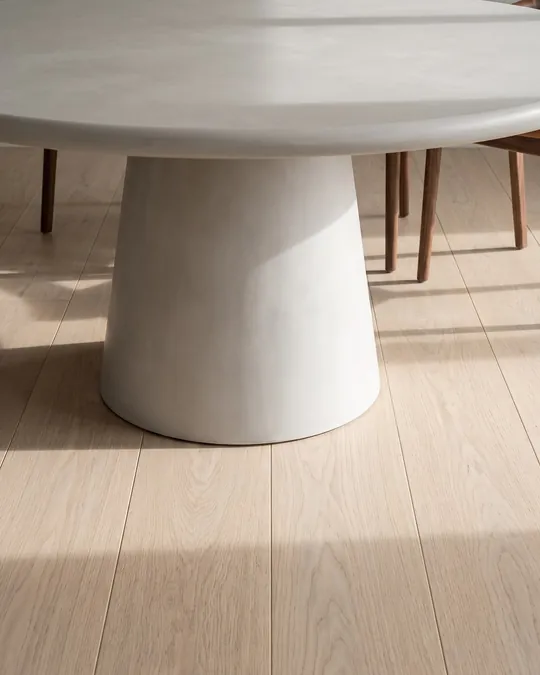
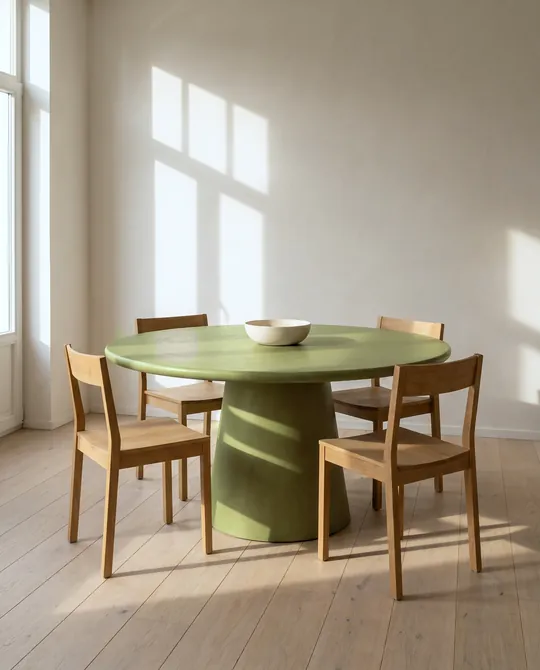
A round table needs the same space on every side. It fits best in a square space, or in a corner of an open-plan room. A round table on a single leg has one advantage: the chairs are never trapped between table legs, so they are easier to move.
In a long room, an oval dining table usually works better. It has no corners, so you get past it more easily, even if the sides are a little tighter. If there is a rug under the table, the space around it also decides how big the rug should be: see Which rug under your dining table?
Try it at home
Not sure? Mark the size of the table on the floor with masking tape or a few pieces of cardboard. Put your chairs around it, push them back as if you are standing up and walk around it a few times. After one evening you know whether it feels right.
After your quote we make the technical drawing for free, with every dimension and the chairs drawn in. Give us the measurements of your dining area and we will check together that the table has enough room. Height also shapes how a table feels: read How high is a dining table?
A table in your shape, size and colour? After your quote, we draw it up for free.