Wabi-sabi is not a style you can buy in a shop. It is a way of looking: at things that are simple, made by hand and do not need to be perfect to be beautiful.
3 min read · Updated 8 November 2026
What is wabi-sabi?
Wabi-sabi is a Japanese way of seeing beauty. Wabi stands for simplicity and quiet, for being content with little. Sabi is about the beauty that time gives to things: a bowl used for years, wood whose colour has softened.
Together they say something we often forget: a thing does not have to be flawless to be beautiful. A small irregularity, a trace of the hand or a subtle nuance is exactly what makes it unique. That is why wabi-sabi is not a set of rules, but an attitude.
Wabi-sabi at home
In an interior, that attitude comes down to a few simple choices:
Fewer, better things. Fewer possessions, chosen with care and kept for a long time.
Natural materials. Linen, wool, clay, stone, raw or oiled wood.
Muted colours. Colours you find in nature: sand, clay, moss, ash.
Light and shadow. No harsh light, but soft light that plays across surfaces.
Traces of the hand. Ceramics, textiles and furniture where you can see that someone made them.
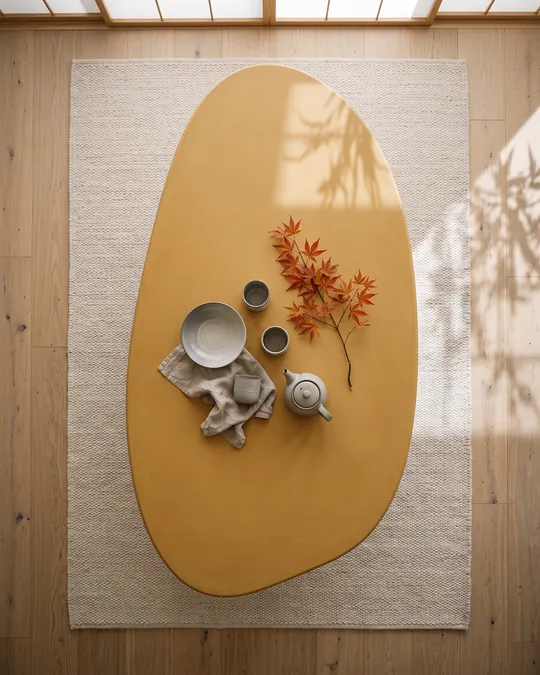
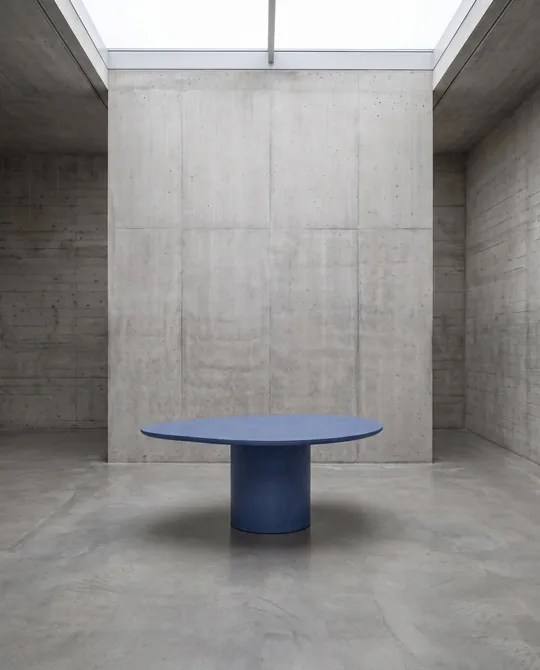
Mortex is a beton ciré that we apply by hand, in six layers. The result is seamless and matt, but never flat or sterile. Subtle nuances, small specks, veining and slight differences in texture are all part of it. That makes every table unique: no two tops are exactly alike.
In many interiors you might see such a nuance as a flaw. In a wabi-sabi interior it is exactly what you are looking for: you can see that the top was made by someone. The matt surface absorbs the light, and the play of light and shadow across it changes throughout the day.
To be honest: if you want a colour that is perfectly even everywhere, without any nuance, Mortex is not the right choice. If you want to see the hand, it is exactly right.
Shapes without straight lines
Wabi-sabi loves shapes that seem to come from nature. An organic dining table does not start from a circle, an oval or a rectangle, but from a free, soft shape: a pebble, a drop, a bean. You choose a shape you love, or you send us your own sketch. Every shape can be made in any size, from 120 to 360 cm long and from 80 to 180 cm wide, so the table fits your room rather than the other way round.
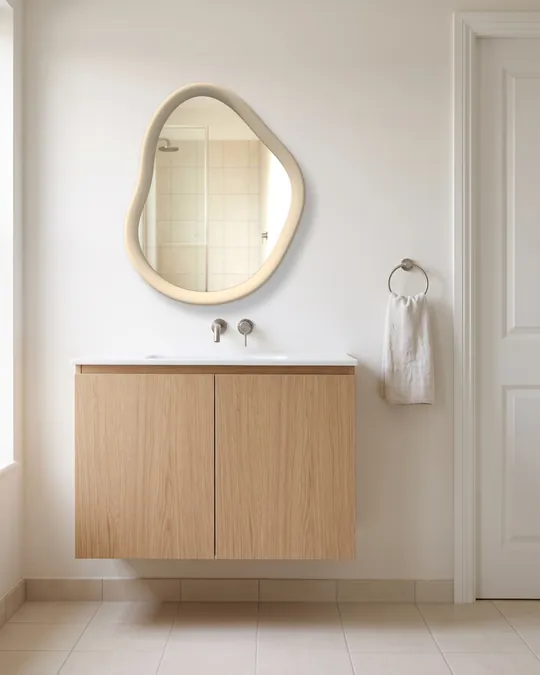
The same idea can carry through the rest of your home. An organic coffee table in the seating area, or an organic mirror with a Mortex frame in the hallway. Where such a mirror looks its best is covered in Where to hang an organic mirror.
How to begin
Start with one piece. A table or a mirror you truly love, and build calmly around it.
Leave space. Empty walls and a clear table top are part of the style.
Choose earthy tones. BM51 Welsh Mid, BM23 Sand Mid, BM28 Shitake Light or BM19 Cacao Mid are calm and warm.
Work with the light you have. The shadow of a window on a matt top is decoration that costs nothing.
An organic table of 240 x 120 cm has a guide price of €3,199, including VAT, and every colour costs the same. Looking for more images? Take a look at Ten dining room ideas with a Mortex table.
A table in your shape, size and colour? After your quote, we draw it up for free.