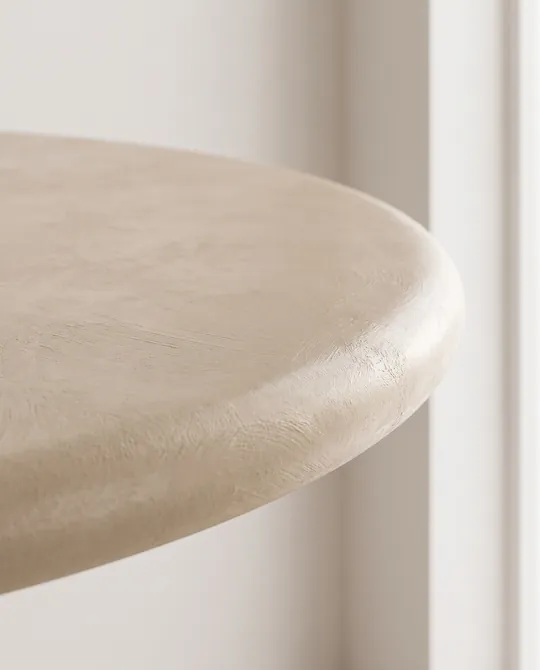
If you are looking for a table with the soft, mineral look of concrete, you soon come across the word Mortex. But what exactly is it, and why do we choose it for every table we make?
3 min read · Updated 8 November 2026
Mortex in one sentence
Mortex is a beton ciré made by Beal International. Beton ciré is the French name for a thin finish that looks like polished concrete, but is applied to a surface in layers instead of being cast in a mould. The result is a skin without joints or seams, with a matt, soft appearance. So Mortex is the brand name, beton ciré the type of finish.
You may know it from floors, walls and bathrooms. On a table it gives the same calm, mineral look, in the shape and size you choose.
Mortex, beton ciré, microcement and concrete look
The names are often used as if they meant the same thing, but they do not. A short overview:
Name
What it is
Mortex
A beton ciré by Beal, applied by hand in layers. Seamless, matt, with subtle nuances.
Beton ciré
The general name for a thin, seamless finish that resembles polished concrete.
Microcement
A similar finish in thin layers, best known from floors and bathrooms.
Concrete look
A look, not a material: a print, laminate or paint that resembles concrete.
Cast concrete
Real concrete in a mould. Beautiful, but heavy and hard to make in a free shape.
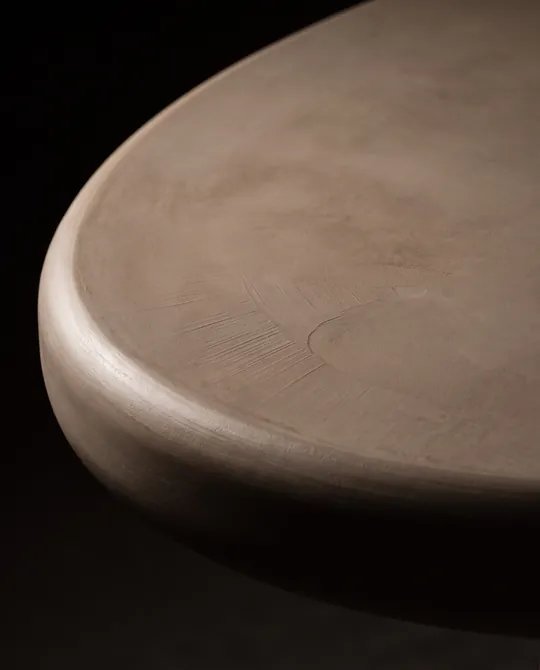
Mortex is matt. It does not shine like lacquered wood or glass, but has a soft, velvety depth. Look closely and you see subtle nuances, small specks and slight differences in texture. That is not a flaw: it is what makes a handmade finish its own.
Because we apply every layer by hand, no two tables are exactly alike. If you want a perfectly even surface, like a print or a ceramic slab, something else will suit you better. If you love a table with character, Mortex gives you exactly that.
Six layers, by hand
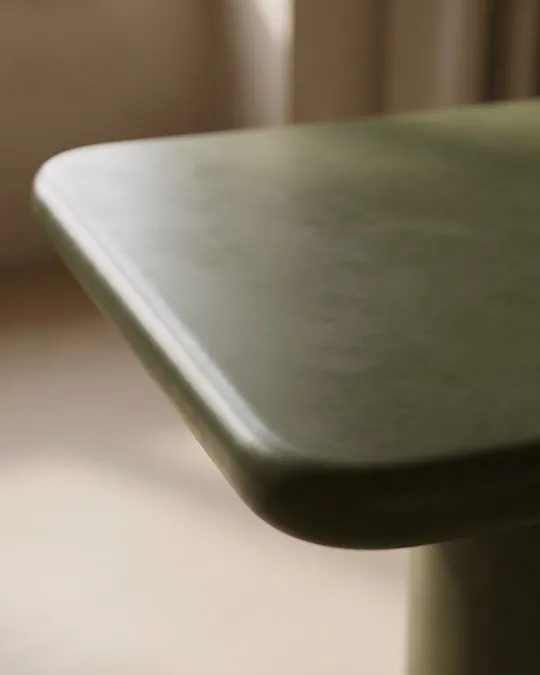
In our workshop we apply the Mortex to the top in six layers, each one by hand. The top and the edge get one continuous skin, with no seam. That also makes free shapes possible: round, oval, Danish, Finnish or Swedish oval, rectangular or organic.
You do not need to know any of this to choose a table. What matters is what you see and feel: a seamless top with a matt, calm finish, in your colour. After your quote we make a free technical drawing, so you see the shape and size of your table before we start.
96 colours, choose from a real sample
Mortex comes in 96 colours, from white and sand to olive, terracotta and deep blue. All colours cost the same. A screen never shows colours quite as they are, so it is best to choose from a real sample. With colour samples at home you see the colour in your own light, next to your floor and your chairs.
Mortex is strong, but it is not stone. Never put a hot pan directly on the top, avoid acidic or aggressive products, and remember that a sharp object scraped across the top can leave marks. A soft, slightly damp cloth is enough for everyday cleaning, and you get a care sheet with your delivery.